Coconut sugar is made from the sap of the coconut palm’s flower, not from the coconut itself. Tappers cut the flower bud so its sap drips into a collector. The sap is filtered, then cooked slowly over a fire until most of its water has evaporated and it thickens into a caramel. That caramel is cooled and worked into crystals, poured into blocks, or kept as a syrup.
Nothing has to be added. Below is how each step works at Samara Farm Indonesia in West Java, and what each step means if you are buying coconut sugar for production or private label.
At a glance
- Raw material: sap from the flower of the coconut palm (Cocos nucifera)
- Process: tap, collect and filter, cook, crystallise, sieve, test, pack
- Formats: crystal (granulated), block (gula jawa) and liquid (nectar syrup)
- Where Samara makes it: West Java, Indonesia, with sap bought directly from smallholder tappers
Step 1: Tapping the coconut blossom
A coconut palm keeps producing new flower stalks. Instead of letting a flower develop into coconuts, a tapper climbs the palm, binds the unopened flower stalk and slices its tip so that sap starts to drip out. A collector hangs underneath to catch it.
At Samara, tappers climb each palm twice a day, at dawn and dusk, before the heat of the day. They slice the blossom by hand so the sap flows clean. One tapper tends up to 30 trees, a skill passed down through generations in West Java.
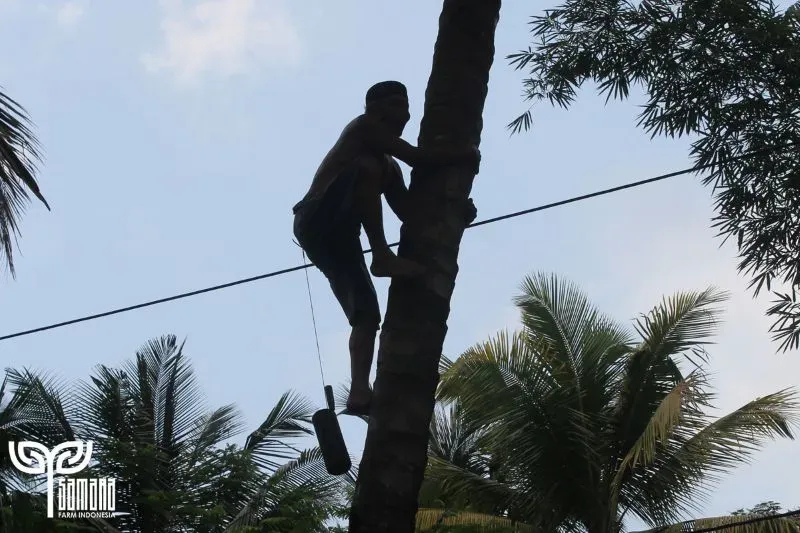 A Samara tapper climbing a palm to tap the coconut blossom.
Step 2: Collecting and filtering the sap
Fresh coconut sap is sweet, clear and mostly water. In tropical heat it starts to ferment within hours, and fermented sap makes darker, sour-tasting sugar that sets poorly. Speed is everything at this stage.
Samara’s bamboo collectors are emptied and the sap is filtered the same morning, then taken straight to the kitchen. That freshness is what gives the finished sugar its golden colour and clean caramel taste, without additives.
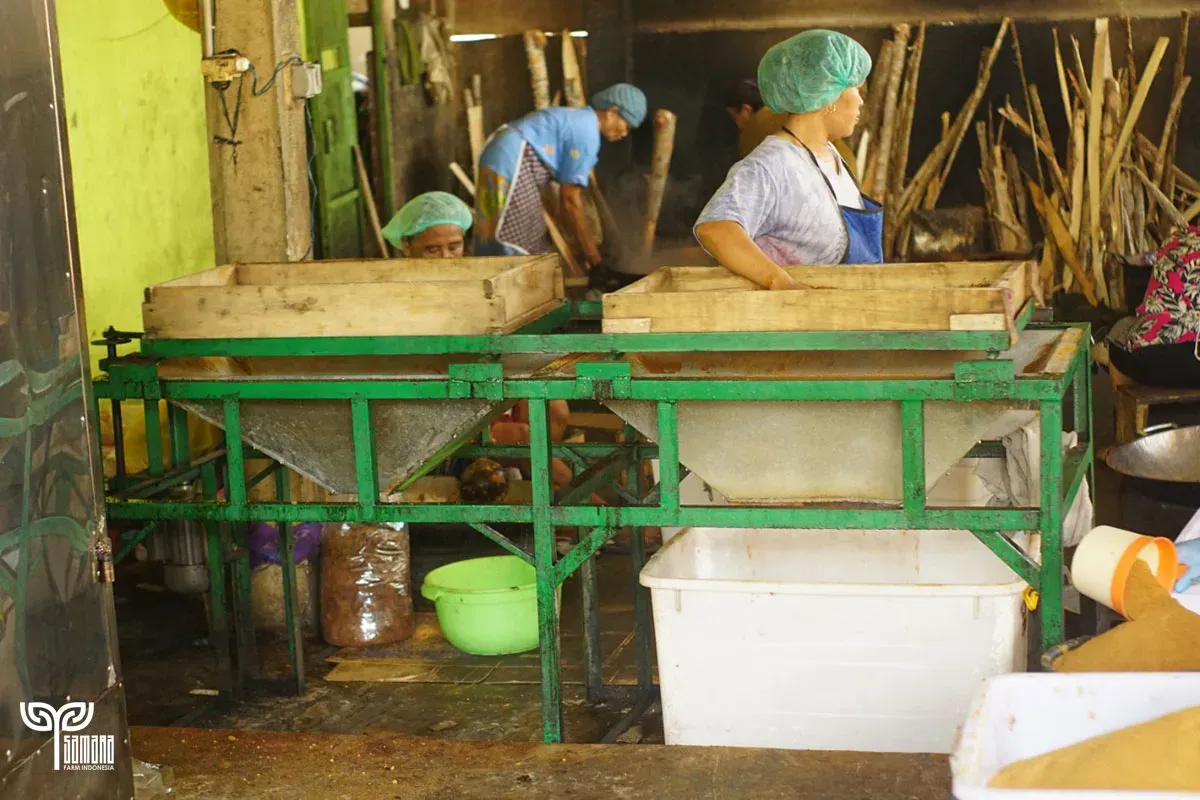 Filtering frames in Samara’s kitchen, with the cooking fires behind.
For buyers: colour and taste consistency start here, not in the factory. Ask a supplier how quickly sap goes from tree to fire.
Step 3: Slow cooking over a wood fire
The filtered sap is cooked in open woks over coconut-wood fires and stirred constantly for hours. As the water evaporates, the sap darkens and thickens into a dense caramel.
Timing takes skill. Cook too fast and the sugar burns; too slow and it never sets. Samara’s cooks judge the moment by sight and smell. This is also the step that sets the flavour: the long, slow cook is where the caramel and toffee notes come from.
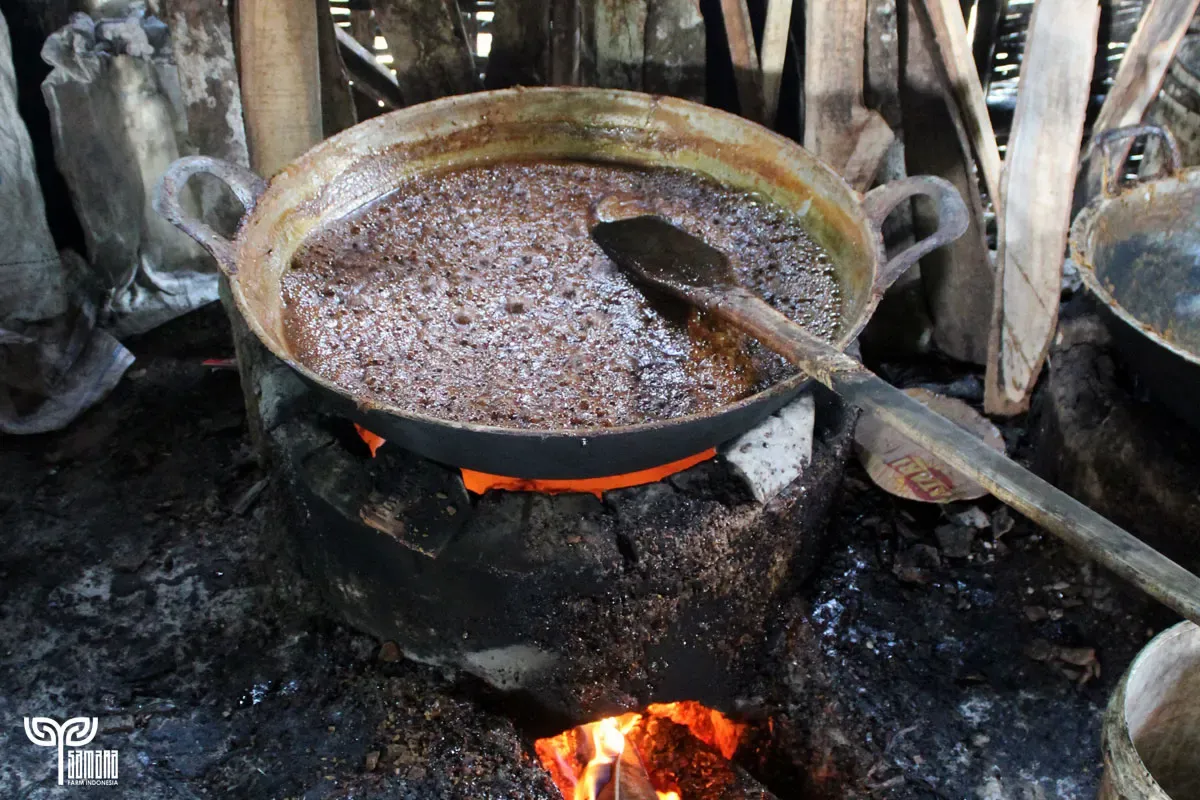 Sap thickening to caramel in an open wok over a wood fire.
Step 4: Crystallising, sieving and grading
What happens next depends on the format.
- Crystal (granulated) coconut sugar: the thick caramel comes off the heat and is worked as it cools until it breaks into free-flowing crystals. These are sieved to the mesh size each buyer specifies.
- Block coconut sugar (gula jawa): the caramel is poured into moulds and left to set. Samara hand-moulds it in the classic cylinder and coin forms used for sauces, kecap and confectionery.
- Liquid coconut sugar (nectar): the sap is kept as a pourable syrup instead of being taken to the crystallising stage. It suits beverages, dressings and bakery lines.
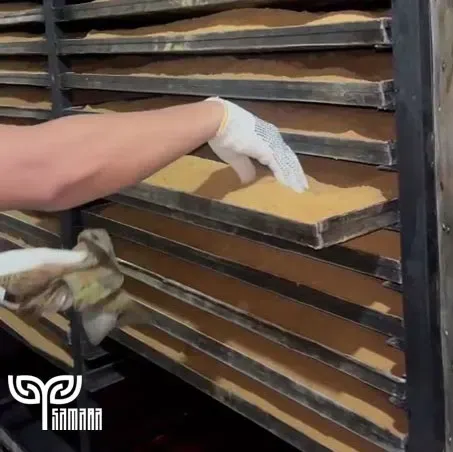 Crystal coconut sugar spread on trays at Samara’s facility.
Every batch of Samara sugar is laboratory tested for moisture and colour before it is released.
For buyers: moisture, mesh size and colour are the specifications that decide how a coconut sugar behaves in your product. See Samara’s coconut sugar specifications.
Step 5: Packing for export
Finished sugar is packed under HACCP conditions:
- kraft bags with food-grade liners for bulk (from 1 kg bags up to 25 kg sacks);
- retail pouches, or jars and sachets under your own brand for private label.
Bags are filled, weighed and metal-detected, then palletised and fumigated for sea freight. Liquid coconut sugar ships in drums or IBCs.
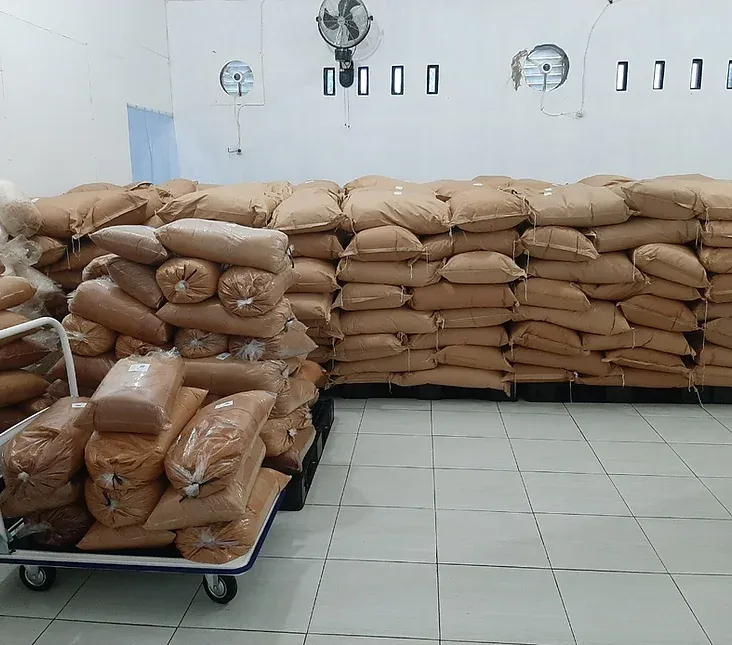 Bagged coconut sugar in the warehouse, ready for container loading.
Containers are loaded at Tanjung Priok, Jakarta, and a full certificate of analysis (COA) travels with every one.
Coconut sugar or palm sugar?
The two terms are often mixed up. Coconut sugar (Indonesian: gula kelapa) comes only from the coconut palm. Palm sugar can also be made from other palms, such as the sugar palm (gula aren). The process is similar, but the source, flavour and behaviour can differ, and some labels use the names loosely.
If the botanical source matters for your labelling or certification, make sure it is stated on the specification sheet. Samara’s coconut sugar is made from coconut blossom sap only.
What to check when you buy coconut sugar
When you compare suppliers, ask for:
- A specification sheet covering moisture, mesh size (for crystal sugar) and colour.
- A certificate of analysis (COA) for the batch you will receive, not just a generic one.
- Valid organic certificates for your market, if you sell organic.
- The botanical source and origin, so there is no confusion with other palm sugars.
- A sample, to test in your own application before you commit to a container.
Samara supplies all of these. Request a sample or read the full organic coconut sugar product page for formats, packaging and minimum order quantities.
Frequently asked questions
Is coconut sugar made from coconuts?
No. Coconut sugar is made from the sap of the coconut palm’s flower, collected before the flower can develop into fruit. The coconut itself, its flesh and its water, play no part in it.
Does coconut sugar taste like coconut?
Not really. Slow cooking caramelises the sap, so coconut sugar tastes of caramel and toffee rather than coconut.
Is anything added to Samara’s coconut sugar?
No. Samara’s coconut sugar is made from coconut blossom sap only, with no preservatives or additives.
Why can coconut sugar vary in colour from batch to batch?
Colour depends mainly on how fresh the sap is and how it is cooked. That is why Samara filters sap the same morning it is collected and lab-tests every batch for moisture and colour before it ships.
What is the difference between coconut sugar and palm sugar?
Coconut sugar comes only from the coconut palm (Cocos nucifera). “Palm sugar” can also come from other palms, such as the sugar palm (aren), and the two names are sometimes used loosely on labels. If the source matters for your product, ask your supplier to state the botanical source on the specification sheet.